
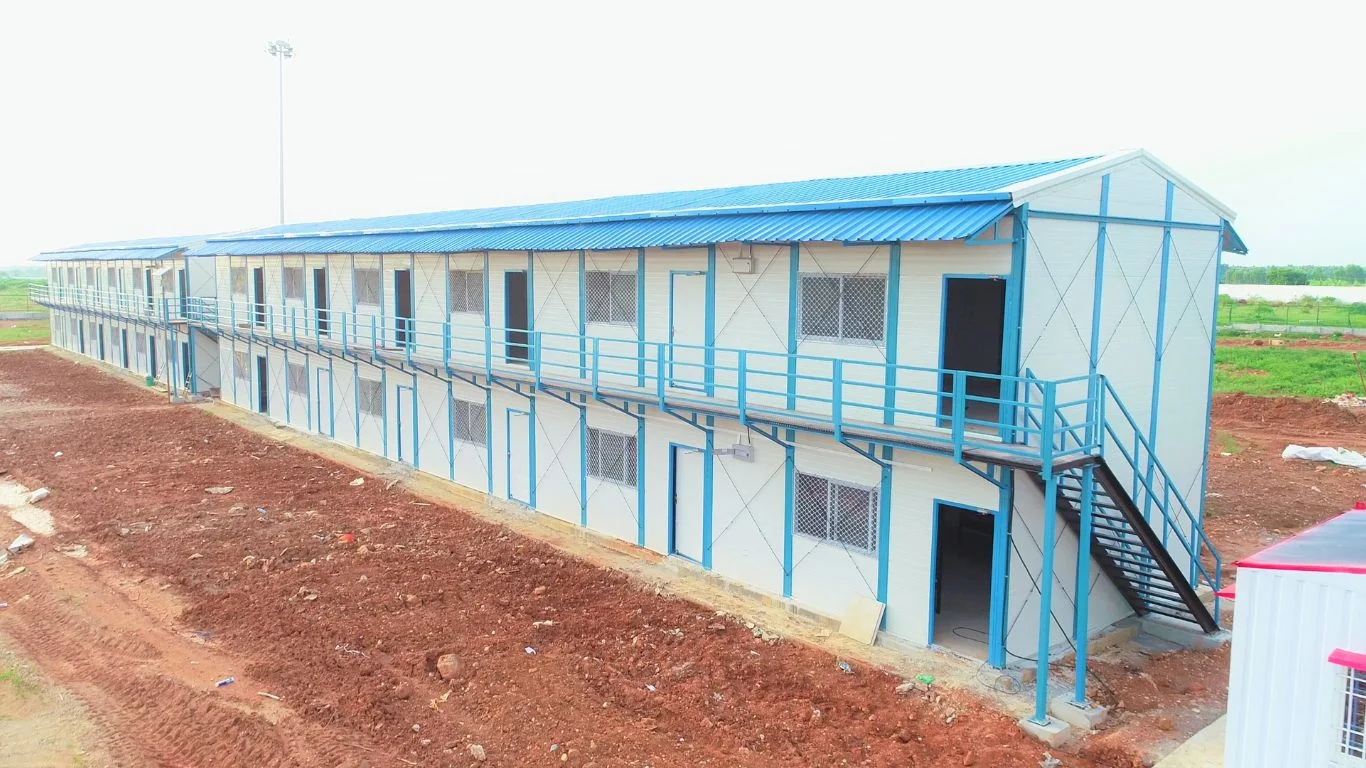
Faster Compliance, Lower Costs, and Better Worker Welfare — Reimagined for Today’s Construction Sites
Labour shortage remains one of the most expensive problems in Indian construction and industrial project execution. Workers routinely leave sites that fail to offer safe, hygienic living conditions — and in 2026, that risk has only grown sharper. With the rollout of India’s four consolidated Labour Codes now active across the majority of states, businesses face tighter scrutiny on migrant worker housing, sanitation, and on-site welfare provisions than ever before.
At the same time, project timelines are getting shorter and land costs are rising, making temporary brick-and-mortar worker housing both slow to build and expensive to write off. Prefabricated labour hutments solve both problems at once: they meet today’s compliance expectations while being faster, cheaper, and far more flexible than conventional construction.
EPACK Prefab manufactures and supplies prefabricated labour hutments across India, built on our proven K-House modular system. We offer a range of layouts and flooring configurations — including G, G+1, and G+2 — engineered for rapid deployment with minimal site equipment or manpower. Here are five reasons why a prefabricated labour hutment should be part of your project planning in 2026.
Explore EPACK’s Prefabricated Labour Hutment Solutions
1. Built for India’s Tightening Labour Compliance Landscape
India’s Building and Other Construction Workers (BOCW) Act has long required employers to provide temporary living accommodation near the worksite for construction labour. What’s changed in 2026 is the level of enforcement and documentation expected — particularly under the consolidated Labour Codes, which mandate clearer standards for migrant worker housing, journey allowances, and welfare provisions.
Prefabricated labour hutments are inherently easier to document and audit than informal on-site sheds. Each unit follows a standardised, repeatable design with defined specifications for sanitation, electrical fittings, and structural safety — making compliance reporting straightforward rather than reactive.
| Requirement | Old Approach (Brick/Tin Sheds) | Prefab Labour Hutment (2026 Standard) |
| BOCW Act Compliance | Often informal, hard to inspect | Modular layout, easy to document & audit |
| Migrant Worker Housing (4 Labour Codes) | Ad hoc, inconsistent quality | Standardised, repeatable, code-aligned design |
| Sanitation & Hygiene | Frequently inadequate | Built-in electrical, sanitary & drainage provisions |
| Weather Resistance | Poor insulation, leaks common | Insulated sandwich panel walls & roof |
| Relocation Between Sites | Demolish & rebuild | Dismantle, transport, reassemble |
For businesses managing inter-state migrant workforces, this standardisation isn’t just good practice — it is increasingly becoming the baseline expectation under current labour regulation.
2. Excellent Thermal Insulation That Cuts Electricity Costs
India’s summers are getting longer and more extreme, and worker housing is often the most neglected part of site infrastructure when it comes to climate comfort. EPACK Prefab’s labour hutments use insulated sandwich panels for both wall and roof cladding — delivering thermal performance that keeps interiors significantly cooler than conventional tin-sheet or uninsulated structures.
This matters in two ways. First, worker retention improves measurably when living conditions are tolerable through peak summer months — a direct lever against the labour shortage problem driving this entire category. Second, where cooling appliances are used, insulated panels reduce the electrical load needed to maintain comfortable temperatures, lowering the ongoing utility cost of running a labour camp for months or years at a stretch.
3. Dramatically Faster Deployment Than Conventional Construction
Prefabrication happens off-site, in factory-controlled conditions, which removes the construction timeline from dependency on local weather, labour availability, or material delivery delays that plague conventional brick-and-mortar builds. Components are manufactured to precise specifications and shipped ready for assembly.
This typically cuts overall construction time by roughly 60% compared to traditional masonry-based worker housing. For project teams working against tight mobilisation deadlines — especially on large infrastructure, industrial, or EPC contracts — this speed difference can be the deciding factor between hitting a project start date or absorbing costly delays before work even begins.
- Manufactured in a controlled factory environment, independent of site weather conditions
- Reduced on-site labour and equipment requirements during installation
- Predictable installation timelines that support accurate project scheduling
4. Portable, Reusable, and a Smarter Long-Term Investment
Unlike permanent worker housing, which is typically demolished or abandoned once a project concludes, EPACK Prefab’s labour hutments are designed for full portability. Structures can be dismantled, transported, and reassembled at a new project location — turning a one-time capital investment into a reusable asset across multiple project cycles.
For contractors and developers running sequential or multi-site projects, this residual value changes the economics of worker housing entirely. Instead of treating accommodation as a sunk project cost, prefabricated hutments become a long-term workforce infrastructure asset that moves with the business.
Modular design also means hutments can be easily expanded — additional frames, wall panels, and roof sections can be added as workforce headcount grows, without rebuilding from scratch.
5. Customisable Layouts That Match Real Project Needs
No two sites have identical workforce housing requirements. EPACK Prefab’s labour hutment system supports a wide range of configurations built around client specifications, including single-storey (G), double-storey (G+1), and triple-storey (G+2) layouts depending on available land and headcount.
Each unit can be customised for room count, ventilation, electrical capacity, and sanitation infrastructure — including drainage and washroom provisions — to match site-specific requirements and local regulatory expectations. This flexibility allows the same core building system to serve a 50-worker remote infrastructure site or a 500-worker industrial campus.
View EPACK’s Porta Cabin & Modular Building Range
Why EPACK Prefab for Labour Hutments
EPACK Prefab is one of India’s leading prefabrication companies, specialising in customised prefab buildings across commercial, industrial, and institutional sectors. Our labour hutment solutions are built on our proven, standardised K-House modular system — engineered for quality, speed, and consistent performance across every project.
- Pan-India manufacturing and delivery capability, with 25+ years of project experience
- 7,400+ completed projects across diverse industrial and infrastructure sectors
- Flexible layouts: G, G+1, and G+2 configurations engineered to client specifications
- Insulated sandwich panel construction for superior thermal performance in tropical climates
- Fully portable design supporting dismantling, relocation, and reassembly at new sites
Contact EPACK Prefab for a Labour Hutment Quote
Need Compliant, Comfortable Worker Housing — Fast?
EPACK Prefab designs and delivers prefabricated labour hutments engineered for India’s climate, labour-law compliance, and rapid deployment. With 25+ years of experience and 7,400+ projects, we help you house your workforce safely, on schedule, every time.
+91-8130444466
|
enquiry@epack.in
|
www.epack.in
Build Smarter. Build Faster. Build Future-Ready.
Frequently Asked Questions (FAQ)
Q: What is a prefabricated labour hutment?
A: A prefabricated labour hutment is a modular worker housing unit manufactured off-site in a factory and assembled rapidly at the project location. It typically uses a steel frame structure with insulated sandwich panel cladding for walls and roofing, offering durable, weather-resistant accommodation for construction or industrial site workers.
Q: Are prefabricated labour hutments compliant with India’s labour laws in 2026?
A: Yes. Prefabricated labour hutments are well-suited to meeting requirements under the BOCW Act and the consolidated Labour Codes, which mandate temporary living accommodation for construction workers. Their standardised design makes documentation and compliance audits significantly easier than informal or ad hoc worker housing arrangements. Businesses should confirm specific state-level rule notifications applicable to their project location.
Q: How long does it take to install a prefabricated labour hutment?
A: Installation timelines depend on project size and configuration, but prefabricated labour hutments typically install in a fraction of the time required for conventional brick-and-mortar worker housing — commonly cited at around 60% faster, since components are manufactured off-site and simply assembled on location.
Q: Can labour hutments be relocated to a new project site?
A: Yes. EPACK Prefab’s labour hutments are designed for portability. Structures can be dismantled, transported, and reassembled at a new location, making them a reusable long-term asset across multiple projects rather than a one-time, single-site cost.
Q: What layout options are available for prefabricated labour hutments?
A: EPACK Prefab offers single-storey (G), double-storey (G+1), and triple-storey (G+2) layout options, each customisable for room count, ventilation, electrical fittings, and sanitation infrastructure based on workforce size and site requirements.
Conclusion
As India’s labour compliance landscape tightens and project timelines compress further in 2026, prefabricated labour hutments have moved from a convenient option to a near-essential infrastructure decision for any business managing an on-site workforce. They offer faster deployment, easier compliance documentation, lower long-term costs, and meaningfully better living conditions than conventional alternatives — directly addressing the labour retention challenges that continue to affect project timelines across the construction and industrial sectors.
EPACK Prefab’s pan-India manufacturing capability and 25+ years of experience across 7,400+ projects make us a trusted partner for businesses looking to house their workforce safely, efficiently, and in full compliance with current labour regulations.
Build Smarter. Build Faster. Build Future-Ready.