India’s renewable energy story is no longer just about megawatts. It’s about the speed, reliability, and scale of everything built around the generation assets — the control rooms, substations, maintenance workshops, and warehouses that make a solar park or wind farm actually function.
As of March 2026, India has crossed 283 GW of installed non-fossil fuel capacity, with solar alone reaching 150 GW and wind crossing 56 GW. The country now ranks 3rd globally in renewable energy installed capacity as per IRENA’s 2026 statistics. The pace of new project commissioning is accelerating every quarter, and that puts enormous pressure on one often-overlooked aspect of every project: getting the right buildings in the right place, fast.
This is where Pre-Engineered Buildings (PEB) have become indispensable.
Why Renewable Energy Projects Need Smarter Infrastructure
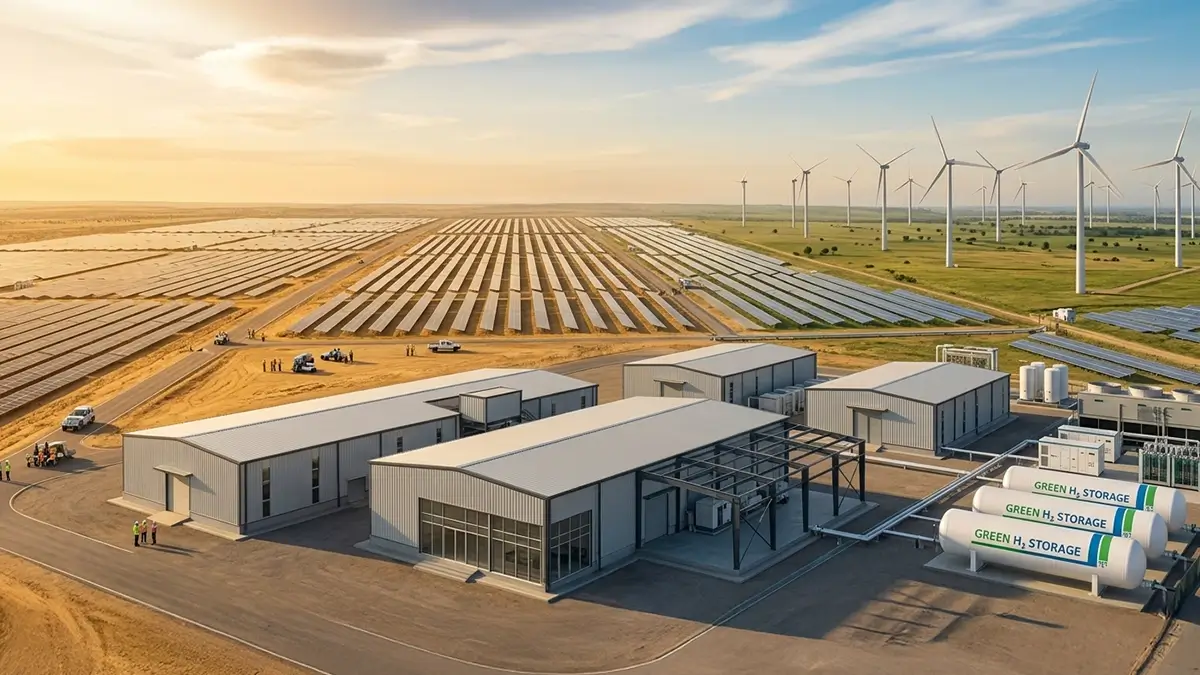
A solar park or wind farm is far more than panels and turbines. Every project requires a working ecosystem of buildings — control rooms, inverter shelters, transformer enclosures, electrical substations, spare parts warehouses, maintenance workshops, and often temporary or permanent accommodation for the project workforce.
Most of these projects are located in remote semi-arid zones, coastal stretches, or elevated terrain — areas where conventional RCC construction is slow, expensive, and logistically complicated. Labour availability is inconsistent, cement and brick transportation adds to cost and delay, and weather windows are narrow.
PEB structures are engineered specifically to address these constraints. They are manufactured off-site, transported to location, and erected quickly — without dependence on large on-site labour forces or complex material procurement chains.
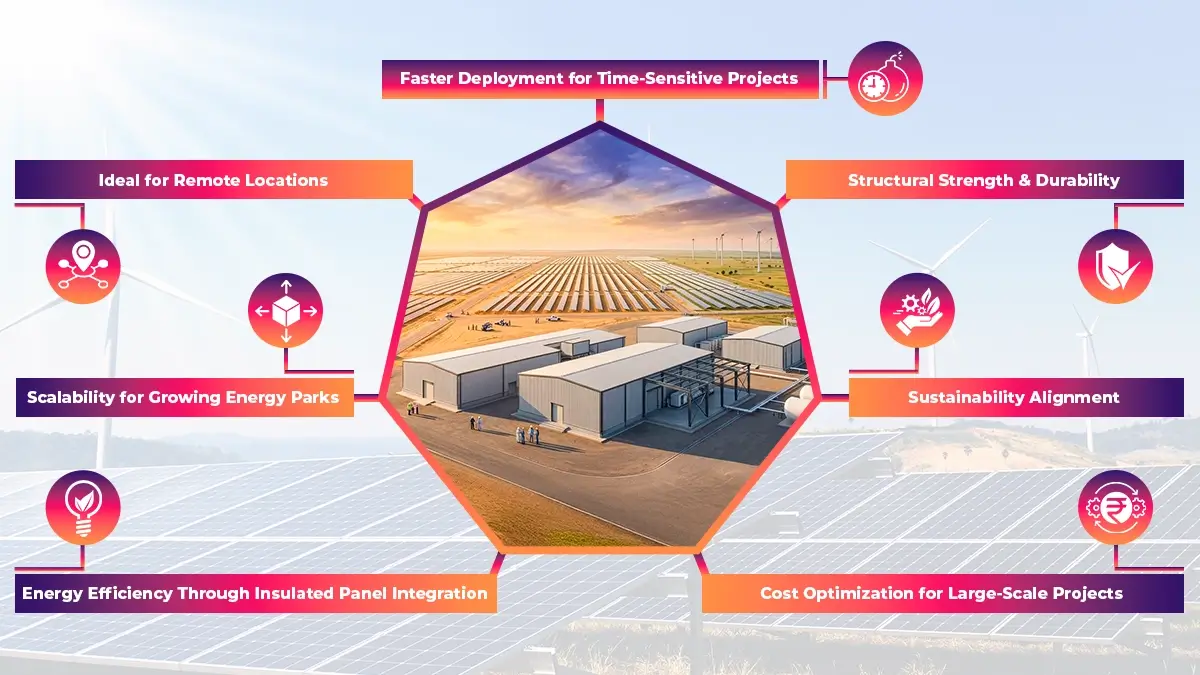
Faster Deployment for Time-Sensitive Projects
Commissioning timelines in the renewable energy sector are rarely flexible. Power purchase agreements, grid connectivity deadlines, and regulatory milestones create hard dates that developers cannot miss.
PEB systems are designed for speed. Structural steel is fabricated at the manufacturing plant to precise specifications, foundation work and fabrication happen simultaneously, and on-site erection takes a fraction of the time compared to conventional construction. For a developer trying to commission a 200 MW solar park on schedule, that time advantage directly translates into revenue.
Built for Remote and Challenging Locations
Renewable energy projects in India are concentrated in regions that are geographically demanding — the Thar Desert in Rajasthan, the wind corridors of Tamil Nadu and Gujarat, the highland sites of Andhra Pradesh. These are not places where you can run a conventional construction site efficiently.
PEB structures are lightweight relative to their strength, easy to transport in components, and require minimal heavy machinery for erection. The construction crew size needed for a PEB project is significantly smaller than for an equivalent RCC structure. In locations where logistics are a constraint, this matters enormously.
Structural Performance in Harsh Environments
Infrastructure built for renewable energy projects must perform reliably for decades, often in conditions that would accelerate wear in a poorly designed structure. High wind loads, thermal cycling from extreme temperatures, wind-driven dust and abrasive particles, and in coastal zones, corrosive salt-laden air — all of these are real engineering challenges.
PEB structures are designed using precise structural analysis. The steel sections are sized for actual load conditions at the specific site, rather than using conservative overbuilding as a substitute for engineering. For coastal and high-humidity environments, appropriate protective coatings and surface treatments are specified at the design stage. The result is a building that holds up across the project lifecycle without requiring constant structural maintenance.
Energy Efficiency Through Insulated Panel Integration
Control rooms and equipment shelters in a solar or wind facility are not just enclosures — they house sensitive power electronics, SCADA systems, and communication equipment that have defined operating temperature ranges. Managing internal temperature in a building located in a desert environment at 45°C ambient requires thoughtful building envelope design.
PEB structures can be integrated with high-performance insulated sandwich panels — PUF panels, Rockwool panels, or Glasswool panels — depending on the thermal performance and fire resistance requirements of the application. This significantly reduces the heat gain through walls and roof, lowering the HVAC load required to maintain internal conditions. Over the life of a project, that translates into meaningful energy and operational cost savings.
Scalability Across Project Phases
Large renewable energy parks are rarely built all at once. Developers often commission Phase 1, begin revenue generation, and then expand progressively as financing, land, and grid capacity allow.
PEB systems are inherently modular. A maintenance workshop built in Phase 1 can be extended laterally. A spare parts warehouse can have bays added without demolishing existing structure. This phased construction approach suits the financial and operational model of most renewable energy developers, and it is something that RCC construction handles far less gracefully.
CAPEX Optimization at Scale
The economics of renewable energy are driven by levelized cost of energy (LCOE). Every rupee saved on balance-of-plant infrastructure contributes to a more competitive project. PEB structures offer real CAPEX advantages — lighter structures require shallower and less material-intensive foundations, factory fabrication reduces material wastage compared to site-based construction, and faster completion reduces financing costs during the construction period.
For developers managing portfolios of multiple projects, the standardization that PEB allows — repeating proven designs across sites — also reduces engineering costs and procurement complexity.
Sustainability Alignment
There is a straightforward logic to using PEB construction for renewable energy projects: the construction method itself should reflect the values of the asset being built. PEB construction generates significantly less on-site waste than conventional methods, uses steel which is a highly recyclable material, and the precision of factory fabrication means material is not over-ordered and discarded. When combined with insulated panel systems, the operational energy footprint of the buildings is also lower.
For developers with ESG commitments or sustainability reporting obligations, this is a meaningful consideration.
Where PEB Structures Are Used in Renewable Energy Projects
PEB buildings serve multiple functions across a typical renewable energy facility:
- Solar power plant control rooms — housing SCADA systems, protection relays, and communication equipment
- Inverter and transformer enclosures — providing weather protection and thermal management for power conversion equipment
- Electrical substation buildings — enclosing switchgear, metering, and protection panels
- Wind farm operations and maintenance buildings — centralized facilities for turbine maintenance crews and spare component storage
- Warehouses for capital spares — storing critical spare parts that cannot be procured quickly in remote locations
- Maintenance workshops — equipped with overhead crane provisions and tool storage
- Modular site offices and workforce accommodation — temporary or permanent facilities for construction and operations teams
How EPACK Prefab Supports Renewable Energy Developers
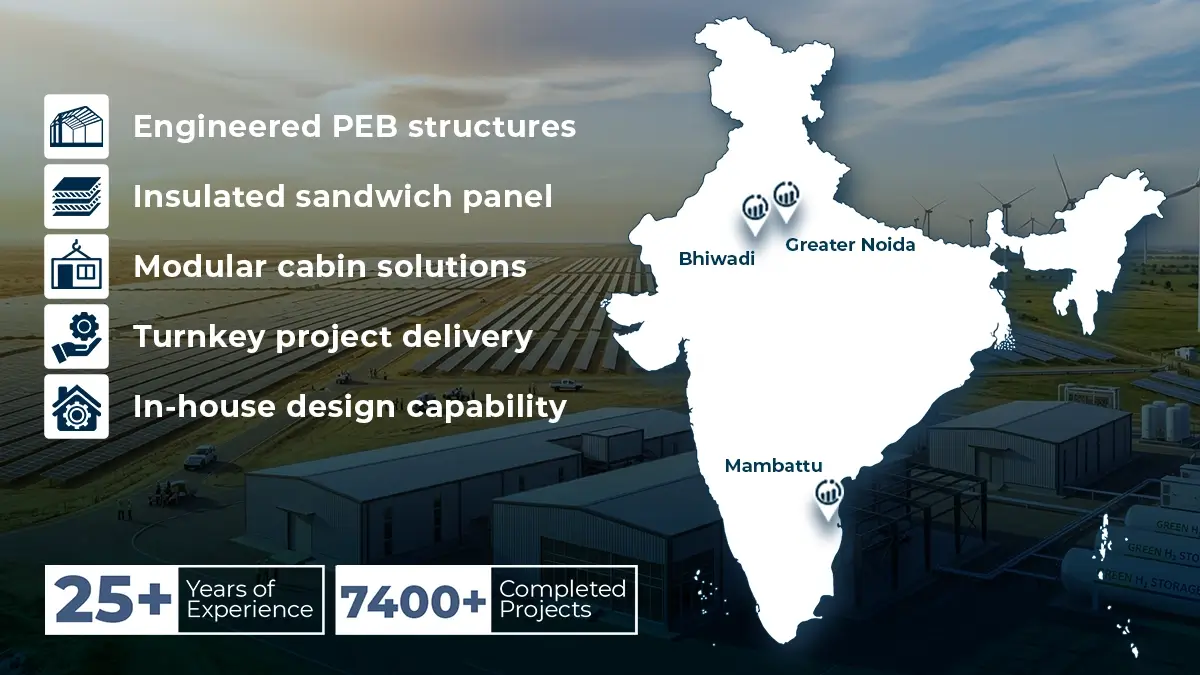
EPACK Prefab, established in 1999 and headquartered in Greater Noida, has over 25 years of experience in engineering and delivering PEB and prefabricated building solutions across India. The company holds ISO 9001:2015, ISO 14001:2015, and OHSAS 18001 certifications and operates manufacturing facilities in Greater Noida (Uttar Pradesh), Bhiwadi (Rajasthan), and Mambattu (Andhra Pradesh) — giving it genuine PAN India supply and project execution capability.
For renewable energy applications, EPACK offers:
- Engineered PEB structures designed for site-specific wind, thermal, and seismic load conditions
- Insulated sandwich panel integration — PUF, Rockwool, and Glasswool — for control rooms and equipment shelters
- Modular cabin solutions for site offices and workforce accommodation
- Turnkey project delivery — from design and fabrication through to erection and handover
- Standardized, repeatable building designs suitable for developers managing multiple project sites
The combination of in-house design capability, multi-plant manufacturing, and on-site execution experience makes EPACK a practical partner for renewable energy developers working on compressed schedules in demanding locations.
Ready to Discuss Your Renewable Energy Infrastructure Needs?
If you are developing a solar park, wind farm, or hybrid energy project and need reliable, fast-track infrastructure — control rooms, substations, maintenance facilities, or warehousing — it is worth having a technical conversation early in your project planning cycle.
Building design decisions made at the concept stage affect your commissioning timeline, your CAPEX, and your long-term operating costs. EPACK’s engineering team can work with your project team to define the right solution for your specific site and schedule.
📩 enquiry@epack.in 📞 +918130444466
Clean energy needs solid infrastructure. Let’s build it right.