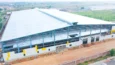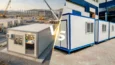

Construction in India is changing rapidly. Every year, developers and builders face growing demand for factories, warehouses, schools, and hospitals — but timelines keep getting tighter and budgets keep shrinking. This is exactly why prefabricated structures and prefabricated walls have become one of the smartest choices for builders and developers across the country.
But what exactly are they? And why are so many people moving away from traditional construction? Let’s understand it in simple terms.
What Is a Prefabricated Structure?
A prefabricated structure is a building where workers manufacture all parts in a factory and then assemble them at the construction site. Traditional construction requires workers to build everything from scratch on site — which consumes more time, more labour, and more material. With prefab, the steel frames, wall panels, and roof sections arrive ready to assemble.
This approach helps builders complete a structure nearly 50% faster than conventional methods — without compromising on strength or quality.
What Are Prefabricated Walls?
Prefabricated walls are factory-made panels that teams transport to the site and install directly. Traditional brick walls demand weeks of building and curing time. Prefab walls go up in just a few hours.
Their biggest advantage is built-in insulation. This keeps your building cooler in summer and warmer in winter — without adding any extra cost or effort after construction.
Types of Prefabricated Wall Panels We Offer
At EPACK Prefab, we offer four main types of wall panels to match your project needs:
PUF Insulated Panels — We recommend these for cold storage, pharmaceutical units, and food processing facilities where precise temperature control matters most.
EPS Insulated Panels — Lightweight and budget-friendly, these work perfectly for site offices, labour accommodations, and portable cabins.
Sandwich Panels — These combine a strong metal exterior with an insulating core, making them a popular choice for industrial walls and roofing across all project types.
LGSF Walls (Light Gauge Steel Framing) — These strong yet lightweight steel frame walls give architects and builders excellent design flexibility for commercial and residential projects.
Why Is Prefab Growing So Fast in 2026?
India’s prefabricated construction market will reach ₹1.22 trillion in 2026 and grow at a CAGR of 12.3% through 2030. This growth does not happen by chance — builders and businesses across India drive it because prefab delivers real, measurable advantages every day.
Key Benefits of Prefabricated Construction
Speed — Prefab builders complete structures up to 50% faster than conventional construction teams. When a deadline is non-negotiable, prefab delivers.
Cost Savings — Using less labour, reducing material wastage, and cutting project timelines all help builders bring overall costs down significantly.
Sustainability — Factory-controlled production generates far less waste than on-site construction. Insulated panels also cut energy consumption inside buildings, helping projects earn green certifications like IGBC and GRIHA.
Flexibility — Do you need more space in the future? Builders can expand, modify, or even relocate prefab structures without tearing down what already exists.
Consistent Quality — Workers manufacture every component in a controlled environment. Bad weather does not cause delays, and inconsistent workmanship does not affect results — builders get reliable outcomes every single time.
Where Are Builders Using Prefab Structures Today?
Prefab is no longer just for industrial sheds. Builders and developers now use it across virtually every sector in India.
Under the PLI scheme, companies are putting up warehouses and factories at record speed. Infrastructure teams are building airport terminals and metro stations with prefab components. In Tier 2 and Tier 3 cities, organisations are setting up schools and hospitals faster than ever. The government uses prefab to push its Housing for All mission forward. And data centre developers choose prefab because it gives them precise, controlled environments quickly.
Today, nearly 50% of government-supported smart city projects in India use modular building systems. The industry’s direction is clear.
Why Choose EPACK Prefab?
EPACK Prefab has delivered end-to-end prefabricated solutions since 1999. Our team handles everything in-house — from design and engineering to manufacturing, logistics, and on-site erection. This approach gives us better quality control, faster delivery timelines, and more competitive pricing than companies that outsource their production.
If you want a construction solution that saves time, reduces cost, and stands the test of time — choose prefab. And choose EPACK Prefab to make it happen.