

India’s industrial expansion in 2026 is driven by three imperatives: speed, scalability, and cost efficiency. From mega warehouses and manufacturing plants to cold storage facilities and logistics parks, the choice of construction methodology has become one of the most strategic decisions at the project planning stage.
At EPACK Prefab — India’s leading Pre-Engineered Building manufacturer with 25+ years of experience and over 7,400 projects delivered — we work closely with industrial developers every day. One question consistently tops every pre-project discussion:
| Should we go with a Pre-Engineered Building (PEB) or a Reinforced Cement Concrete (RCC) structure? |
In this article, we break down both construction systems across every critical parameter and explain why industrial developers in India are increasingly choosing PEB for large-scale infrastructure projects in 2026.
Understanding the Two Construction Systems

What Are Pre-Engineered Buildings (PEB)?
Pre-Engineered Buildings are steel-based structural systems where all components — primary frames, secondary members, roof and wall panels — are precision-engineered in a controlled factory environment and then assembled on-site using bolted connections. The result is a high-strength, lightweight structure that can be erected far faster than conventional buildings.
PEB structures are widely used for:
- Warehouses and distribution centres
- Manufacturing plants and industrial sheds
- Cold storage and food processing facilities
- Large-span structures requiring column-free interiors
- Institutional and infrastructure projects
What Are RCC Structures?
Reinforced Cement Concrete (RCC) structures are built through traditional on-site processes — placing steel reinforcement bars, constructing formwork (shuttering), pouring concrete, and waiting for curing cycles to complete. This method has been the backbone of Indian construction for decades.
RCC is commonly used for:
- Multi-storey commercial and residential buildings
- Institutional buildings such as hospitals and schools
- Structures requiring high fire resistance as a primary design criterion
Key Comparison Parameters
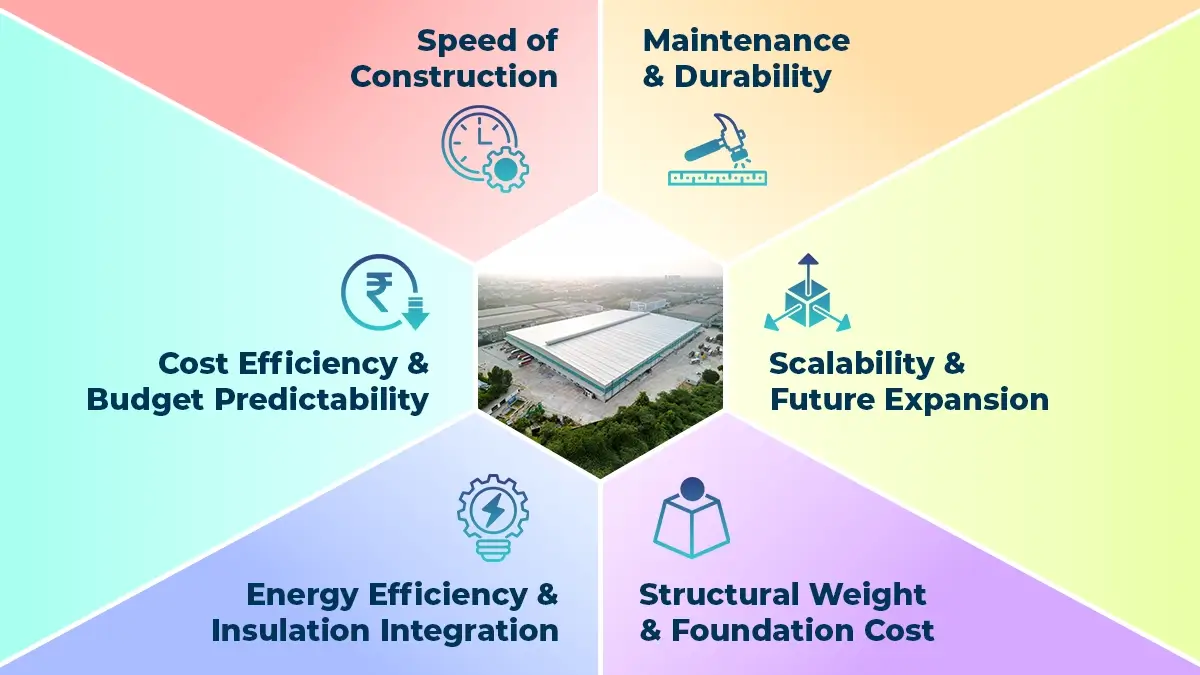
1. Speed of Construction
In 2026, time-to-market is a decisive competitive advantage. PEB construction allows foundation work and factory fabrication to happen in parallel — meaning your steel structure can arrive on-site ready to erect while civil work is still being completed. Typical PEB projects are completed 30–50% faster than equivalent RCC structures of the same scale.
RCC construction requires sequential execution: shuttering must be set up, concrete poured, and curing time observed (typically 21–28 days per slab) before the next phase can begin. Weather dependency further extends timelines. For industrial developers where every week of delay means lost revenue, this is a significant disadvantage.
| EPACK Advantage: With in-house manufacturing and a production capacity exceeding 1,47,122 MT per annum, EPACK Prefab ensures faster project delivery timelines across India. |
2. Cost Efficiency and Budget Predictability
PEB structures are engineered to optimise every kilogram of steel — using tapered sections and optimised profiles that significantly reduce material consumption compared to conventional structures. Lower labour requirements, minimal on-site wastage, and faster completion all contribute to lower total project cost.
RCC projects are more vulnerable to cost overruns due to material price fluctuations (cement, aggregates), high on-site labour dependency, and timeline delays that inflate overhead costs. Budget predictability is harder to achieve.
For industrial developers managing multi-crore capex, the cost predictability of PEB is a major advantage.
3. Scalability and Future Expansion
Industrial operations rarely stay the same. Capacity expansions, additional bays, mezzanine additions — PEB structures are designed for exactly this flexibility. Horizontal expansion of a PEB building can typically be completed with minimal disruption to ongoing operations, often over a weekend.
Expanding an RCC structure requires heavy structural modification — breaking walls, adding beams, and significant downtime. For fast-growing businesses, this inflexibility is a real constraint.
4. Structural Weight and Foundation Cost
PEB structures use engineered steel components that are 30–40% lighter than equivalent RCC frames. This directly reduces the foundation load, which in turn reduces foundation depth, reinforcement, and civil cost — especially significant in projects built on medium or weaker soil conditions common across many industrial zones in India.
5. Energy Efficiency and Insulation Integration
Modern industrial projects demand high thermal performance to control operating costs. PEB structures integrate seamlessly with insulated sandwich panel systems — PUF (Polyurethane Foam) panels, Rockwool panels, and glass wool panels — as roof and wall cladding.
EPACK Prefab manufactures insulated sandwich panels with a production capacity of approximately 13,10,000 square meters per annum, ensuring consistent supply for large-scale projects. These panels deliver superior thermal insulation, reducing HVAC loads and long-term energy costs significantly.
In contrast, RCC walls require additional insulation layers and cladding systems to achieve comparable thermal performance, increasing both cost and construction complexity.
6. Maintenance and Long-Term Durability
EPACK’s PEB structures use factory-coated steel with anti-corrosion treatments, ensuring long service life with minimal maintenance intervention. Quality control in factory fabrication is significantly higher than on-site RCC construction, which can be affected by inconsistent material quality, weather during curing, or variations in site workmanship.
RCC structures are susceptible to cracking, spalling, and carbonation over time in industrial environments. Repair cycles are longer and more disruptive to operations.
Application Suitability: PEB vs RCC in 2026
| Application | PEB Structure | RCC Structure |
| Warehouses | Preferred | Not Recommended |
| Manufacturing Plants | Preferred | Limited Use |
| Cold Storage Facilities | Highly Preferred | Rarely Used |
| Commercial High-Rise | Not Suitable | Preferred |
| Heavy Industrial Sheds | Preferred | Limited Use |
| Multi-Storey Structures | Limited Use | Preferred |
| Logistics & Distribution Hubs | Highly Preferred | Not Recommended |
The pattern is clear: for industrial infrastructure — warehouses, factories, cold storage, and logistics hubs — PEB is the default choice in 2026. RCC retains relevance in multi-storey commercial construction and specific institutional applications.
Why Industrial Developers Prefer PEB in 2026
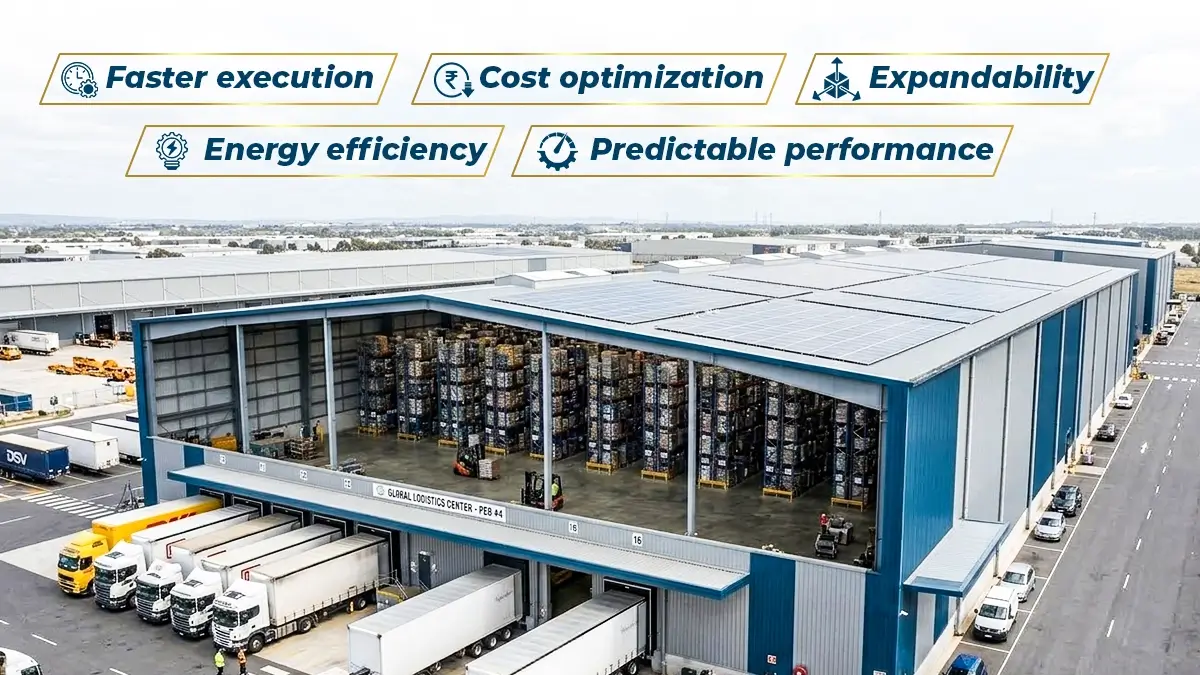
The convergence of several macro trends is accelerating PEB adoption across India:
- India’s warehousing and logistics sector is expanding rapidly, driven by e-commerce growth and the PLI (Production Linked Incentive) scheme, creating demand for fast-delivery, large-span structures.
- Cold chain infrastructure investment is at an all-time high, and PEB with integrated insulation is the most technically and economically viable solution for temperature-controlled facilities.
- Industrial developers are increasingly penalised for delays — faster PEB construction directly protects project IRR.
- Green building and sustainability requirements are pushing projects toward energy-efficient insulated panel systems, where PEB has a clear advantage.
- Pan-India developers need a consistent, scalable solution that can be replicated across locations — PEB’s standardised engineering approach makes this possible.
How EPACK Prefab Supports Modern Industrial Development
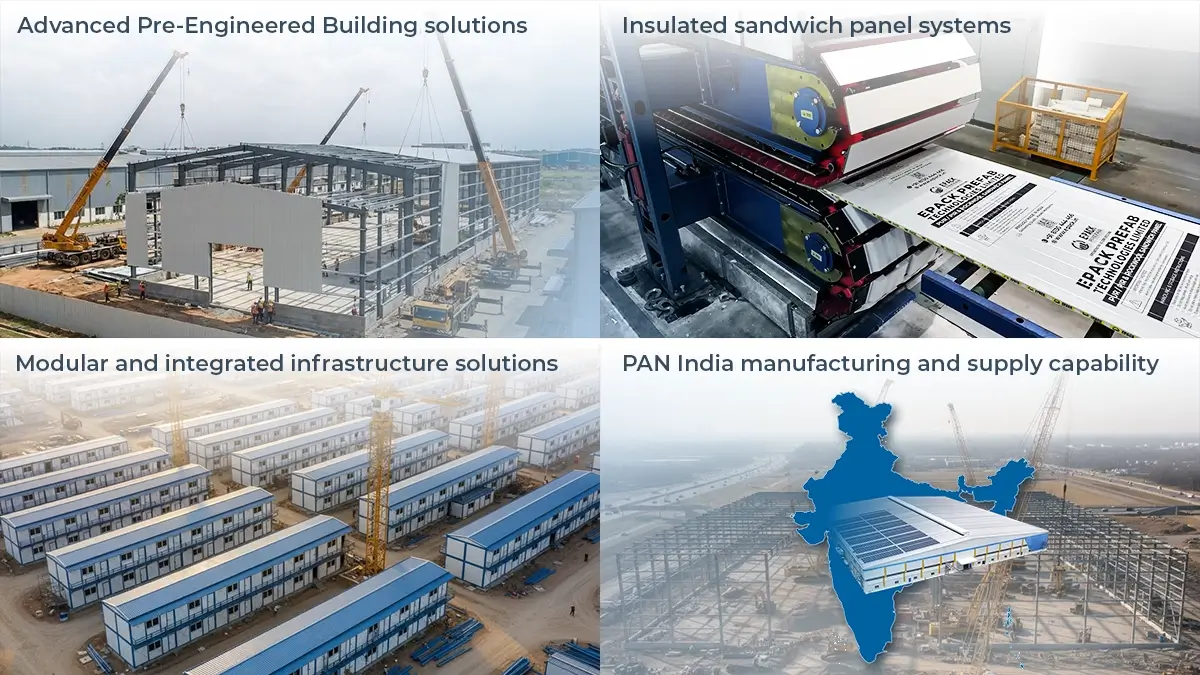
As one of India’s largest Pre-Engineered Building manufacturers, EPACK Prefab delivers end-to-end industrial infrastructure solutions — from engineering design through manufacturing, supply, and project execution.
- Advanced Pre-Engineered Building (PEB) design and supply with an annual manufacturing capacity of 1,47,122 MT
- Insulated sandwich panel systems (PUF, EPS, Rockwool) manufactured at 13,10,000 sqm per annum
- Modular and integrated infrastructure solutions including porta cabins and prefabricated structures
- Pan-India presence with manufacturing and supply capability across all major industrial zones
With 25+ years of industry experience, 7,400+ completed projects, and a client portfolio spanning warehousing, pharmaceuticals, FMCG, cold chain, automotive, and institutional infrastructure, EPACK Prefab is equipped to deliver your project on time, on budget, and built to last.
Frequently Asked Questions
Q: Can PEB structures be built for multi-storey industrial facilities?
A: Yes, PEB structures can be engineered for multi-level mezzanine floors within large industrial bays. However, for multi-storey commercial or residential towers, RCC remains the standard structural choice. PEB is optimised for large-span, single to three-storey industrial applications.
Q: How long does it take to build a PEB warehouse in India?
A: A typical PEB warehouse of 10,000–20,000 sqft can be erected and made operational within 45–90 days from order placement, depending on scope. RCC structures of comparable size typically take 4–8 months. EPACK Prefab’s in-house manufacturing capability ensures predictable delivery timelines.
Q: Is PEB construction suitable for cold storage facilities?
A: Absolutely. PEB is the most preferred structural system for cold storage and temperature-controlled warehousing. The integration of high-performance PUF insulated sandwich panels with the steel structure delivers superior thermal efficiency, which is critical for cold chain operations. EPACK Prefab has delivered numerous cold storage projects across India.
Q: How does PEB compare to RCC in terms of fire resistance?
A: Bare steel does have lower inherent fire resistance than concrete. However, PEB structures can be fireproofed using intumescent coatings or fire-rated boarding systems to meet IS and NBC requirements. For standard industrial applications, fireproofing requirements are manageable and do not significantly impact cost or timeline.
Q: Are PEB structures approved for use across Indian industrial zones?
A: Yes. PEB structures are fully compliant with IS 800 (steel structures) and other relevant Indian Standards. They are widely approved and used across industrial, SEZ, and logistics park developments across India. EPACK Prefab’s designs are engineered to comply with all applicable Indian building codes and seismic zone requirements.
Conclusion
In 2026, the decision between PEB and RCC is not a close call for most industrial applications. Pre-Engineered Buildings offer faster construction, lower lifecycle costs, easier expansion, and seamless insulation integration — all of which align directly with the needs of modern industrial developers in India.
RCC continues to serve specific building types well — particularly multi-storey commercial and institutional structures. But for warehouses, factories, cold storage facilities, logistics hubs, and industrial sheds, PEB is the clear and growing preference.